Andrew.
It was Andrew.
Wednesday, May 13, 2020

Sunday, November 3, 2019
Winning equals success
"Ya know there's a great stat out today, because this is Getzlaf's 1000th game. In the last 40 years, there are only six players that have played 1000 games for one franchise and have won as many games as Ryan Getzlaf has won, which is 548 going into action tonight. And I think that also speaks volumes about the type of success this Anaheim franchise has had with Getzlaf as their marquee center."
OH YOU DO? WHAT ELSE COULD IT POSSIBLY MEAN???
OH YOU DO? WHAT ELSE COULD IT POSSIBLY MEAN???
Tuesday, October 8, 2019
REVOLUTIONARY

Wednesday, September 25, 2019
Simulations are in.

Happy 2019 everyone. See you guys AH ROOOUUNND
-A'sparagu
Monday, July 9, 2018
Friday, May 25, 2018

Friday, March 31, 2017

Tuesday, November 8, 2016
This a Test of Your Emergency Broadcast System
Hey folks! As the Trumppocalypse approaches and the yard signs brandishing your political views, sort of like that Appalachian hookers tramp stamp of a butterfly with the "Daddy" insignia, start to come down (or get come on)...
We. Must. Blog.
As the great Jefferson Davis once said, "All we ask is to be let alone."
Ok I'm off my soapbox. Let's do some quick hits, stretch our legs and take this dog for a walk.
Raffi Torres retired...go gently into that great light, sweet prince.
John Scott retired and brews beer now...good luck I guess. I never really gave a shit about you.
Jacob Trouba signed a bridge deal...This about sums it up. In all seriousness, congratulations to everyone that held out hope and kept this guy in your fantasy line-up. I'd expect pretty big dividends when you drop him for LITERALLY ANYONE ELSE...
Marian Hossa has 500 goals...and his daughter booped his nose at the celebration. Me.
That's all the time I have for now. This felt good, felt right, but for now I'll get back to my day job.
Stay Golden.
We. Must. Blog.
As the great Jefferson Davis once said, "All we ask is to be let alone."
Ok I'm off my soapbox. Let's do some quick hits, stretch our legs and take this dog for a walk.
Raffi Torres retired...go gently into that great light, sweet prince.
John Scott retired and brews beer now...good luck I guess. I never really gave a shit about you.
Jacob Trouba signed a bridge deal...This about sums it up. In all seriousness, congratulations to everyone that held out hope and kept this guy in your fantasy line-up. I'd expect pretty big dividends when you drop him for LITERALLY ANYONE ELSE...
Marian Hossa has 500 goals...and his daughter booped his nose at the celebration. Me.
That's all the time I have for now. This felt good, felt right, but for now I'll get back to my day job.
Stay Golden.
Friday, August 14, 2015
You Want More? You'll Get It.
Eventually.


The media has really caught on to the idea that there are certain repeatable skills in the NHL. Measuring these skills has been labeled "analytics" and the only ones who are really making decisions based on things unrelated to analytics are NHL General Managers. Oops!
Luckily for us, not everyone gets it. A few people think they do, but it isn't the "Summer of Any Stats Ever lol", it's the "Summer of Misunderstanding Analytics."
Quick, what do Jeff Skinner's rookie campaign and his 2013-2014 season have in common?
Shit, I dunno. I'll just take a dumb guess. Uhhh...he had a shooting percentage above his NHL career average.
If you guessed that he had a shooting percentage above his NHL career average, you win the prize.
Finally, I can retire. Good night, internet!
Skinner has a career shooting percentage of 10.5%. During his rookie year he shot at a 14.4% rate. When he next potted in excess of 30 goals, he was shooting at a rate of 12%, still a good 1.5% above his mean. What about Eric Staal's two best scoring years? Yup, you guessed it. His shooting percentage was well above his career average too.
First, two of these seasons were cut short; one by injuries and one by greed. In each season, he projects for 25 goals across 82 games. Is that a below average season? Is that a bad goal-scoring season? No, it isn't. It isn't cherry picking his 2 best seasons, but we're only 6 goals off.
Second, do you know how many more goals he would've scored if he'd shot his mean this year? 6 more. Six. Or about the difference between his pace in those shortened years and his "career best."
When conducting research into shooting percentage it is easy to make some assumptions and some generalizations.
Exactly. Ok, maybe I've been too harsh. I'll do a quick CTRL+F here...

Well, that was unexpected.
They sometimes just don't hold water. However, increases in shooting % generally lead to improved offensive years. More specifically, when a player shoots above his career average, he tends to have a year of high offensive output. Conversely, when players shoot below their career average, their offensive output can be characterized as "disappointing".
Do I really have to parse this? I mean, c'mon.
Another generalization is that players that shoot over the average league shooting percentage tend to be better scorers.
Get out.
Here's something fun. In 2013-14, the average shot percentage in the NHL was 8.9%. You have to go all the way down 89th in the goals that year to find someone who shot below average. Brad Richards, Dustin Byfuglien, Erik Karlsson, and Radim Vrbata all tied with 20 goals for 89th place. Two of them were defensemen.
Players who score more will have higher shot percentages and higher point totals. This is not worth mentioning.
Getting back to young Jeff, much can be concluded about the "what", but not as much about the "why". That is more based on educated guesswork. Consider a couple of extrapolations. Last year his shooting percentage was a dismal 7.7%. For the last two years, the league average was about 9.1% (which includes the historically lower percentages of the blueliners). If Skinner merely returns to his average, he likely scores 25 goals.
I already mentioned this. Do you read my articles about your articles before you post your articles?
And, I'll check again but...

Just making sure I didn't spell anything incorrectly.
With his lifetime assists to goals ratio of .88, one can estimate that Jeff ends up with around 47 points. That is a significant improvement over last season's 31 points.
Are we allowed to do that? Just add assists willy-nilly? I expect Danny Briere to have a career year in 15-16, based on his lifetime assists-to-goals ratio.
Jeff Skinner had teammates that sucked. He skated most with Victor Rask, Elias Lindholm, Alex Semin, and Riley Nash. Is that a list of good players in 2015? No. It isn't. It's a miracle Jeff Skinner had 13 assists. What a stud.
Another important and related statistic is the number of shots taken. Simply put, scorers need to be taking a lot of shots. Skinner's NHL average in this area is 234. In 2013-14, he took 275 shots and, of course, he scored 33 goals that year. His rookie year he only took 215 shots but some of that can probably be attributed to "new kid" nerves and, frankly, he was making the most of his high quality opportunities.
Superb undermining of your own argument. Taking more shots is important, except for when it isn't and then we need to use clichés and hyperbole because we just can't explain why sometimes, gosh-darn-it, the puck just goes it for some crazy reason rofl!
What about those guys that would be considered comparable to Jeff Skinner? Again, normalizing for partial years and extracting the strike shortened season, the same assumptions seem to hold true for them. Consider these three players: Tyler Seguin, Logan Couture, and Kyle Turris. All 1st round draft picks, all in the league about the same amount of time, and all considered goal scorers.
Are they? I would consider Couture a goal-scorer and Seguin is an all-around scoring star, but Turris? Kyle Turris is about 60-40 assists-to-goals and his career high in goals in 26. Even Seguin seems just as content setting up a play than he does scoring himself.
First, let's look at Tyler Seguin. He's got a career shooting % of 11.7% and averages 237 shots per season. His best years were 2013-14 and 2014-15 when he had 84 points, a shooting percentage (SH%) of 12.6% and 77 points with a SH% of 13.2% respectively.
And also got traded to Dallas and played with ART ROSS WINNER JAMIE BENN. Jamie Benn vs. Victor Rask, Alex Semin, and Riley Nash. If you ADD ALL THREE their point totals fall short of what Benn put up last year. Unreal.
Logan Couture's lifetime average is 11.7% with an average of 249 shots per season. His 2nd and 3rd best scoring years had him shooting at nearly a full percentage point above his career average. In 2013-14, shooting well below his average led to his lowest goal scoring output (23). Last year was one of those outliers where he shot below his career average (10.3%) but still saw him put up a career best 67 points. Those point totals did include a higher proportion of assists however.
He skates with Patrick Marleau and saw over 11% of his ice time last year on the power play with Joe Thornton and Joe Pavelski. Over 12% of the time, Couture was on the ice with 2 of Pavelski, Thornton, and Marleau while the other team had fewer players and often he was with all 3.
Jeff Skinner didn't play 11% of the time on the power play period (Is Bill Peters drunk?), let alone with 3 other good forwards. Not that he'd have the chance anyway. It's looking more and more like Jeff Skinner's 18-goal season was phenomenal.
Lastly, Kyle Turris, historically not a high volume shooter, exceeded his average shots per season in the last two years by nearly 60 shots (215 vs. 158). Accompanying this his shooting percentages of 12.1% and 11.2% easily bested his 10.2% career average. His point totals were clear beneficiaries at 58 and 64 points in those last two years. In each case these young scorers seem to confirm that an improved shooting % leads to better scoring performances.
How about just getting older and better? These are dudes hitting their prime years and they are improving in the points department. They are older so coaches trust them more in scoring situations and with more ice time.
Also, in Turris' case, if in 14-15, he would've shot below his career shot % (and we'll be fair and give him the same deviation, dropping his career mark by 1% to 9.2) he would've had four fewer goals.
4.
And still would've set a career high for points. Do I have to continue? This is torture.
Does this same pattern hold true for more veteran scorers?
God, please kill me.
The research does indeed show a similar correlation.
Prove it.
Using the Eric Staal examples mentioned above, he has a SH% of 10.9%. His best years he shot 16.1% and 12.3% scoring 100 and 82 points respectively. Last year he underperformed in this category with a 9.4% rate. If Staal performed at his career average and using the same extrapolation that was used with Skinner earlier, he scores around 64 points. To add to last year's woes for Eric, he shot nearly 30 less shots than his career average of 272.
Fewer. You meant to type fewer.
What about players comparable to Staal? Two of Rick Nash's three best offensive years had him shooting at a 15.2% and 13.8% clip, well above his career 12.5% mark.
Just going to ignore that other season from Rick Nash? Well, I'm not.
I guess the author just sorted by points. The difference between Nash's 2nd "best" season and his 5th is...three points. 3. points.
I have to think at this point in the article, you stopped to think just for a moment, "Championing shot percentage might not be such a hot idea. Maybe I'm learning something new here and shot percentage really doesn't mean all that much because it's so full of noise and context. Eh fuck it, no one reads this shit."*
*my actual thoughts when making fun of strangers on the internet
Corey Perry, a career 13.4% shooter, posts 98 and 82 point seasons when he shoots at a rate of 17.2% and 15.4%, well over his 13.4% average. Similarly, Joe Pavelski's two best offensive seasons came when he shot an incredible 18.2% and 14.2% (79 and 70 points). Again, this was well above his lifetime NHL average of 11.5%. To reiterate, players, especially goal scorers, who exceed their historical shooting percentage averages tend to have excellent overall offensive years.
I'm not repeating myself. See: everything I've written.
There are, of course, the Jiri Hudler's of the world whom are emblematic of the SH%/scoring relationship. This past year he had one of his best, shooting at an incredible 19.6% clip, scoring 76 points. Sporting a 15.1% career average, Hudler is clearly either a sharp-shooter or a "right place/right time" kind of player. Another mold breaker is Alex Ovechkin. He led the league with nearly 400 shots, scored 53 goals, while sporting an impressive career SH% of 12.4%. The other "superstars" like Crosby (14.4%), Malkin (12.8%), and Getzlaf (12.4%) all exceed league averages by a large percentage.
How does this make Ovechkin a "mold-breaker"? What mold? He shoots a lot. He scores a lot. He shot percentages a lot. This is proving your argument.
Without a doubt, there are those scorers, often higher volume shooters, where this relationship is more tenuous. Take Henrik Zetterberg for example. In a number of years he has shot well below not just his personal career shooting percentage but also below league average and still posted 70, 80, 69, and 66 point seasons. Just this past year Claude Giroux had a pretty successful 73 point season shooting at 9%. Even Pavel Datsyuk is a bit of a riddle with his career SH% of 14.4%, but his two best years he shot below his career average at 11.7% and 12.9% (hitting 97 points in both of those years). He was, however, well above league averages.
These are set-up men. These are players who enjoy and will occasionally employ an action that can take place during a hockey game called a "pass". Often, passes can lead to goals. There's no riddle to it. I know you understand this. I'm losing my mind. I'm going to break out in hives.
The shooting percentage statistic seems to be a pretty fair indicator of individual success but less a measure of team success. Take the Hurricanes two most recent post-season years. During the Cup run they had the second highest shooting percentage in the league at 11.2% while the league was averaging 10.3%. However during the 2008-09 season the Canes shot a mere 8.8% vs. a league average of 9.6% (good enough for 25th in the league). Yet, in the last 10 years the Hurricane's team shooting percentage has only been in the NHL's top 10 twice, the previously mentioned Cup year and 2009-10 when the Canes were 10th. Could there be a correlation to team success there?
I'm going to paraphrase so that maybe I can cook up some logic:
-Shot % does not tell you how well a team did.
-When the Hurricanes were good, they had a great shot %.
-In the smallest season sample size of 1 season, they had a low shot %, but made the playoffs.
-In a WHOLE FUCKING DECADE, they've shot like blind grandmas playing croquet and have been a crap team for nearly the entire duration.
-Of course there is.
BONUS FUN!
2014-15 Calgary Flames 2nd in the league in shot percentage
2013-14 Colorado Avalanche 2nd
2012-13 Toronto Maple Leafs 1st
These teams all sucked, but made the playoffs because they shot at a percentage which is unsustainable compared to their possession numbers beyond 80-90 games.
I've concluded that shot percentage shows you who got lucky and who will probably not be so lucky next year. I mean, look at this.
And yet...

So what does all of this mean for the Carolina Hurricanes in 2015-16? Shooting percentage can indicate a lot of things: the quality of the chance, the accuracy of the shot, the movement of the puck, the quality of the playmakers, and the overall creativity of the team.
The 2015-16 Carolina Hurricanes: The NHL's First 5-on-0 Showdown.
There is a difference between playing the Oilers and the Rangers that might help or hurt your shot %. Maybe not. What do I know?
Here is one final set of thoughts to ponder. If Jeff Skinner and Eric Staal merely performed up to their historic career shooting percentages, they would have posted an additional 26 points between them. If Riley Nash hits his career average, he's a 30-35 point player.
His career average is apparently 5-10 points higher than his career best. Figure that out.
More importantly if Jordan Staal comes close to his career shooting % rate, he's at or around the 50 point mark. Those performances alone won't likely get the Canes into the playoffs, but it will make a big difference. Add in moderate improvements from Rask, Lindholm plus a full year of Nestrasil and this team can be offensively competitive. In the best Jim Mora voice that can be mustered, no promises were made about "Playoffs".
If Jordan Staal plays at all, it'll help. Not much, but he's better than Jay McClement.
There are two things that will help Carolina. Better players is one....hmmm...no matter how hard I try I just can't seem to search for the other.
Tuesday, April 28, 2015
If April is for fools, this month will never end.
What is it about the playoffs anyway?
We've made so much progress in recent years when it comes to logic and reasoning in sports analysis. In spite of all the corny names, the NHL version of sabermetrics has forced its way into relevancy. It's becoming increasingly rare to hear about goalie wins and team chemistry. High shot percentages are chalked up to small sample size instead of some magical repeatable skill or an ability to be clutch when it really matters. The days of rostering goons to "protect" the star players are almost completely behind us. Isn't it wonderful? I like to think we had something to do with that. You're welcome, loyal Tyutinites(We've gained somewhat of a cult following over the years. They like to be referred to as Tyutinites. I have no idea why. Why DO we call you guys Tyutinites, anyway?).
And then, come playoff time, everything gets thrown out the window.
Like spoiled milk, moldy cheese and that Russian dressing that’s been on the fridge door since the Bush administration, Ken Hitchcock has an expiration date.
Why does it have to be spoiled and moldy to have an expiration date? The fresh bottle of ketchup in your fridge expires too, ya know. That unopened bottle of Billy's Hit it a TON barbecue sauce on the counter? Pretty sure that'll expire before too much longer. And I know there's a dill pickle somewhere in Woodhaven just waiting to be eaten.
Look, there’s no denying the effect Hitchcock had on this franchise. His systematic structure produced four straight playoff years – Year 1 had him taking over for Davis Payne after 13 games – with the Blues twice finishing first and twice finishing second.
So that means it's time to get rid of him? You have a weird way of proving a point.
But their six-game bow to the Minnesota Wild is the third straight season that they’re out on their asses in the first round. This year’s loss came at the expense of the best roster, on paper, that GM Doug Armstrong has given his coach.
Oh boy. OK, so here's the thing. It's hard to win in the playoffs. Because you're no longer playing Edmonton and Buffalo. There aren't any cupcake first round match-ups anymore. Every team that qualifies for the playoffs is a good team. Hell...some of the teams that don't qualify are good. Boston, Los Angeles, San Jose? Pretty decent hockey teams. Dallas scored the 2nd most goals in the NHL this year, and they're watching hockey on TV.
In 2012, St. Louis lost to Los Angeles. Ya know, the team that smoked everybody on their way to a Stanley Cup. I'm aware, they were an 8 seed, but it's not like they were undeserving.
In 2013, St. Louis lost to Los Angeles. Once again, can you really blame them for that?
In 2014, St. Louis lost to Chicago. Hey, look. Chicago was pretty good that year.
There's a reason Chicago and Los Angeles have dominated the league the last few years. They're both really awesome teams.
And it wasn’t against the Kings or the Blackhawks. It was against a team they should have beaten.
I'll admit that Minnesota isn't Chicago or LA, and it's possible St. Louis was the favourite to win that series, but you have to realize how unbelievable Minnesota was in the 2nd half of the season. They acquired Devan Dubnyk on January 14th. At that time, they were 18-19-5, nine points out of the 2nd wild card spot. The next 40 games resulted in a 28-9-3 record with a +44 goal differential. That wasn't a hot week. That was half the season.
These aren't your 2014-15 Ottawa Senators. This team was projected to be good all year. Despite just a 7-7 record, NHL.com still had them as the 7th best team in the league, citing bad luck as the only thing holding them back. Well, their bad luck may have continued longer than expected, but boy did it turn around. These things tend to sort themselves out over the course of a full season(Ottawa be damned). That's why people talk about small sample sizes. I thought we were past this?
I'm not saying they're a .735 hockey team, but they certainly weren't a .488 team either. They're probably about halfway between those two figures. Ya know...a pretty good team. St. Louis lost to a pretty good team.
Did you watch the Blues vs. Wild series? Was there anything you saw that would indicate they’re jumping in front of a bullet for their coach?
Is that what you think happened? You think they purposely lost because they wanted to make their coach look bad? You don't think players have enough pride to try their hardest whether they like their coach or not? The Kings did. Twice. There's no way any of those guys like their coach. I mean, look at that guy.
Especially when you consider not a single player on the Blues' playoff roster has ever won a cup before. They knew they had a good team. They knew they had a legitimate shot at a cup run. But yeah, you're probably right. They deliberately booted the entire season in six games so their coach would get fired. Weird how they still won two of them.
Maybe Oshie's 9.4% playoff shot percentage has something to do with it. Ya know, since his worst season has him shooting at a 10.1% clip, and his career is at 11.8%. And as for Backes? His 8.5% playoff shot percentage is hardly in line with his 12.5% career percentage.
The idea of “message fatigue” is a very valid thing in the NHL. How many times have you seen a gruff coach replaced by a players’ guy, or vice versa?
Yes, but how often does it work? My guess is about half the time. For every fairy tale ending(the Kings with Sutter, the Penguins with Bylsma, the Blackhawks with Quenneville) there's a disaster(the Canucks with Tortorella, the Capitals with Hunter, the Capitals with Oates). Just because this is something teams often do doesn't make it a cure-all. And did you notice anything about those teams? They're all young, exciting teams that were on the cusp of being great. You can say a coaching change was the answer, I'll just say it was an inevitability, and we can agree to disagree.
Look, it’s not an easy decision to move off Hitchcock. Ask the Penguins what it’s like to jettison a successful coach for the sin of playoff underachievement.
See? You already knew that. Why did you write this article?
The funny thing about that is Bylsma got canned for not having success in the playoffs, a few years after he got praised for his success in the playoffs. Message fatigue? Maybe. Luck? Definitely. There are sixteen teams in the playoffs every year. All things equal, that means each playoff team has a 6.25% chance of winning the Stanley Cup. All things aren't equal, I understand, but they're not different enough to drastically sway odds in one direction or another. This is just the reality of things. We live in an era of parity. We wanted this. This is the reason we implemented a salary cap. Teams don't just go through the playoffs wiping people away year after year anymore.
Hitchcock has no room to grow. This is the ceiling for himself and the Blues. Jake Allen could have been Jacques Plante in this series and it doesn’t change the fact that, yet again, this group under Hitchcock scored four goals in their four losses.
I don't know if you understand this, but that's how hockey works. Teams scored 2.73 goals per game this year. For every winner there's a loser. If teams are averaging under three goals per game it stands to reason that the losing team of most games didn't have a lot of goals.
Take out the six-goal explosion in Game 4, and the Blues scored eight goals in five games.
Yeah, but take out the anemic one goal performances, and the Blues scored ten goals in two games. Coach Yeo had no room to grow in those games! Dubnyk could have been Jacques Plante and it didn't change the fact that Minnesota only scored two goals in their two losses.
You can't just remove data from an already small sample just to prove a point. Otherwise you end up sounding like an idiot like I just did. St. Louis scored 14 goals in six playoff games, 2.33 goals per game. Minnesota's elite shot prevention style of play held opponents to 2.45 goals per game this season. Not too far off, really.
Hitchcock will be fine. The Maple Leafs, Sharks and Flyers are three teams that might throw money at him if he's available. And why not: The next expiration date is in 2019...
Cute. But what was that you were just saying about same crap, different year?
We've made so much progress in recent years when it comes to logic and reasoning in sports analysis. In spite of all the corny names, the NHL version of sabermetrics has forced its way into relevancy. It's becoming increasingly rare to hear about goalie wins and team chemistry. High shot percentages are chalked up to small sample size instead of some magical repeatable skill or an ability to be clutch when it really matters. The days of rostering goons to "protect" the star players are almost completely behind us. Isn't it wonderful? I like to think we had something to do with that. You're welcome, loyal Tyutinites(We've gained somewhat of a cult following over the years. They like to be referred to as Tyutinites. I have no idea why. Why DO we call you guys Tyutinites, anyway?).
And then, come playoff time, everything gets thrown out the window.
Like spoiled milk, moldy cheese and that Russian dressing that’s been on the fridge door since the Bush administration, Ken Hitchcock has an expiration date.
Why does it have to be spoiled and moldy to have an expiration date? The fresh bottle of ketchup in your fridge expires too, ya know. That unopened bottle of Billy's Hit it a TON barbecue sauce on the counter? Pretty sure that'll expire before too much longer. And I know there's a dill pickle somewhere in Woodhaven just waiting to be eaten.
His first head-coaching job in the NHL remains his longest tenured one: Seven years with the Dallas Stars, 503 games, with a Stanley Cup and two Western Conference titles.
Then came four years and 254 games with the Philadelphia Flyers before being fired in 2006. Then came four years and 284 games with the Columbus Blue Jackets before parting ways in 2010.
You've found a pattern! He'll coach St. Louis for three more years and they'll win a cup? Tyler! I have great news!
He’s coached the St. Louis Blues for four seasons and 281 games.
Time’s up.
Oh. Nevermind, Tyler. Life sucks.Look, there’s no denying the effect Hitchcock had on this franchise. His systematic structure produced four straight playoff years – Year 1 had him taking over for Davis Payne after 13 games – with the Blues twice finishing first and twice finishing second.
So that means it's time to get rid of him? You have a weird way of proving a point.
But their six-game bow to the Minnesota Wild is the third straight season that they’re out on their asses in the first round. This year’s loss came at the expense of the best roster, on paper, that GM Doug Armstrong has given his coach.
Oh boy. OK, so here's the thing. It's hard to win in the playoffs. Because you're no longer playing Edmonton and Buffalo. There aren't any cupcake first round match-ups anymore. Every team that qualifies for the playoffs is a good team. Hell...some of the teams that don't qualify are good. Boston, Los Angeles, San Jose? Pretty decent hockey teams. Dallas scored the 2nd most goals in the NHL this year, and they're watching hockey on TV.
In 2012, St. Louis lost to Los Angeles. Ya know, the team that smoked everybody on their way to a Stanley Cup. I'm aware, they were an 8 seed, but it's not like they were undeserving.
In 2013, St. Louis lost to Los Angeles. Once again, can you really blame them for that?
In 2014, St. Louis lost to Chicago. Hey, look. Chicago was pretty good that year.
There's a reason Chicago and Los Angeles have dominated the league the last few years. They're both really awesome teams.
And it wasn’t against the Kings or the Blackhawks. It was against a team they should have beaten.
I'll admit that Minnesota isn't Chicago or LA, and it's possible St. Louis was the favourite to win that series, but you have to realize how unbelievable Minnesota was in the 2nd half of the season. They acquired Devan Dubnyk on January 14th. At that time, they were 18-19-5, nine points out of the 2nd wild card spot. The next 40 games resulted in a 28-9-3 record with a +44 goal differential. That wasn't a hot week. That was half the season.
These aren't your 2014-15 Ottawa Senators. This team was projected to be good all year. Despite just a 7-7 record, NHL.com still had them as the 7th best team in the league, citing bad luck as the only thing holding them back. Well, their bad luck may have continued longer than expected, but boy did it turn around. These things tend to sort themselves out over the course of a full season(Ottawa be damned). That's why people talk about small sample sizes. I thought we were past this?
I'm not saying they're a .735 hockey team, but they certainly weren't a .488 team either. They're probably about halfway between those two figures. Ya know...a pretty good team. St. Louis lost to a pretty good team.
Did you watch the Blues vs. Wild series? Was there anything you saw that would indicate they’re jumping in front of a bullet for their coach?
Is that what you think happened? You think they purposely lost because they wanted to make their coach look bad? You don't think players have enough pride to try their hardest whether they like their coach or not? The Kings did. Twice. There's no way any of those guys like their coach. I mean, look at that guy.
Especially when you consider not a single player on the Blues' playoff roster has ever won a cup before. They knew they had a good team. They knew they had a legitimate shot at a cup run. But yeah, you're probably right. They deliberately booted the entire season in six games so their coach would get fired. Weird how they still won two of them.
The Blues have two players at the heart of their lineup who have been there for years – David Backes and T.J. Oshie. They’re beloved by fans. They’re leaders on the team. They’re vital members of the community. They’re really, really good guys.
But their playoff numbers, and lack success(sic), could be as scrutinized as those of their coach.
Backes had one goal and one assist against the Wild, giving him two goals and four assists in his last 16 playoff games. Oshie … well, let us know when he shows up for the first round.
That seems weird. I wonder what changed? Certainly they didn't just forget how to play hockey, right? So something must be different. Something that isn't just bad luck and random variation, because the only cure for bad luck is time and patience. The only thing I can think would be a lack of clutch ability, right? Can't get it done when it really matters, when all eyes are on you? That must be what you're getting at, because I can't think of anything else. But wait. Don't you remember the 2014 Olympics? Oshie sure made a name for himself there, as you yourself even pointed out. No bigger event, I'd say, than when the whole fucking world is watching, as you find yourself repeatedly locked in a one on one skills competition against the goalie of the host nation. Sure seemed pretty cool and calm under that pressure.Maybe Oshie's 9.4% playoff shot percentage has something to do with it. Ya know, since his worst season has him shooting at a 10.1% clip, and his career is at 11.8%. And as for Backes? His 8.5% playoff shot percentage is hardly in line with his 12.5% career percentage.
If you believe the core is the problem, then you take a melon baller and scoop out these two this summer. They both have enormous value. Maybe it’s just not going to happen in St. Louis.
Or maybe it will, with a new voice behind the bench.
Or, maybe it will with the same coach! Who knows?The idea of “message fatigue” is a very valid thing in the NHL. How many times have you seen a gruff coach replaced by a players’ guy, or vice versa?
Yes, but how often does it work? My guess is about half the time. For every fairy tale ending(the Kings with Sutter, the Penguins with Bylsma, the Blackhawks with Quenneville) there's a disaster(the Canucks with Tortorella, the Capitals with Hunter, the Capitals with Oates). Just because this is something teams often do doesn't make it a cure-all. And did you notice anything about those teams? They're all young, exciting teams that were on the cusp of being great. You can say a coaching change was the answer, I'll just say it was an inevitability, and we can agree to disagree.
Look, it’s not an easy decision to move off Hitchcock. Ask the Penguins what it’s like to jettison a successful coach for the sin of playoff underachievement.
See? You already knew that. Why did you write this article?
The funny thing about that is Bylsma got canned for not having success in the playoffs, a few years after he got praised for his success in the playoffs. Message fatigue? Maybe. Luck? Definitely. There are sixteen teams in the playoffs every year. All things equal, that means each playoff team has a 6.25% chance of winning the Stanley Cup. All things aren't equal, I understand, but they're not different enough to drastically sway odds in one direction or another. This is just the reality of things. We live in an era of parity. We wanted this. This is the reason we implemented a salary cap. Teams don't just go through the playoffs wiping people away year after year anymore.
Hitchcock has no room to grow. This is the ceiling for himself and the Blues. Jake Allen could have been Jacques Plante in this series and it doesn’t change the fact that, yet again, this group under Hitchcock scored four goals in their four losses.
I don't know if you understand this, but that's how hockey works. Teams scored 2.73 goals per game this year. For every winner there's a loser. If teams are averaging under three goals per game it stands to reason that the losing team of most games didn't have a lot of goals.
Take out the six-goal explosion in Game 4, and the Blues scored eight goals in five games.
Yeah, but take out the anemic one goal performances, and the Blues scored ten goals in two games. Coach Yeo had no room to grow in those games! Dubnyk could have been Jacques Plante and it didn't change the fact that Minnesota only scored two goals in their two losses.
You can't just remove data from an already small sample just to prove a point. Otherwise you end up sounding like an idiot like I just did. St. Louis scored 14 goals in six playoff games, 2.33 goals per game. Minnesota's elite shot prevention style of play held opponents to 2.45 goals per game this season. Not too far off, really.
So once again, it’s goaltending and a lack of goal scoring. Same crap, different year, and something’s gotta change.
We imagine it’ll be behind the bench before it’s anything substantial from the roster Armstrong’s built.
Look. I know it's a little late for a disclaimer, but I'm just gonna throw it out there. I don't know things. I'm just a dude who watches a lot of hockey. I read about it occasionally and I do my best to analyze what I learn. I have no idea what goes on inside a locker room. I don't know what happens during practices and in film rooms. These things are kept from us. All of us. One of the biggest things we've yet to accurately analyze are the effects of coaching. But don't you think players at the NHL level have had enough coaching? They've had so many different coaches over their many years through the ranks, there can't really be too much more for them to learn. There aren't any brand new systems nobody else has thought about. I just see it as such a cop out to switch coaches when things don't go as planned. People are so quick to overreact, so in order to appease the fans they show the coach the door. Problem solved, apparently.Hitchcock will be fine. The Maple Leafs, Sharks and Flyers are three teams that might throw money at him if he's available. And why not: The next expiration date is in 2019...
Cute. But what was that you were just saying about same crap, different year?
Thursday, April 9, 2015

Wednesday, January 7, 2015
S̶o̶m̶e̶t̶i̶m̶e̶s̶ ̶n̶u̶m̶b̶e̶r̶s̶ ̶l̶i̶e̶.̶ ̶W̶e̶l̶l̶,̶ ̶m̶a̶y̶b̶e̶ ̶i̶t̶'̶s̶ ̶p̶e̶o̶p̶l̶e̶'̶s̶ ̶i̶n̶t̶e̶r̶p̶r̶e̶t̶a̶t̶i̶o̶n̶ ̶o̶f̶ ̶t̶h̶e̶ ̶n̶u̶m̶b̶e̶r̶s̶.̶ ̶A̶n̶d̶ ̶I̶ ̶g̶u̶e̶s̶s̶ ̶t̶h̶e̶y̶'̶r̶e̶ ̶n̶o̶t̶ ̶l̶y̶i̶n̶g̶,̶ ̶p̶e̶r̶ ̶s̶e̶,̶ ̶i̶f̶ ̶t̶h̶e̶y̶ ̶a̶c̶t̶u̶a̶l̶l̶y̶ ̶b̶e̶l̶i̶e̶v̶e̶ ̶w̶h̶a̶t̶ ̶t̶h̶e̶y̶ ̶s̶a̶y̶ ̶t̶o̶ ̶b̶e̶ ̶t̶r̶u̶e̶,̶ ̶r̶i̶g̶h̶t̶?̶ ̶M̶a̶y̶b̶e̶ ̶p̶e̶o̶p̶l̶e̶ ̶a̶r̶e̶ ̶j̶u̶s̶t̶ ̶d̶u̶m̶b̶.̶ Sometimes people are dumb.
Recently, some very intelligent people have talked about Patrik Elias's historic night, recording his 1,000th career point. According to Puck Daddy, it was good enough to earn him 1st star of the night honors. I know what you're thinking: Who the fuck gives a shit? The answer? Pretty much nobody. Including me, really. But I like to make fun of people anonymously over the internet from the safety of my mom and dad's basement. It makes me feel like a manman. So, lucky you Puck Daddy!
Ok. So, Elias had a goal and two assists last night. That's a nice game. Filled the stat sheet pretty well. On some nights, that'd be worthy of 1st star of the night honors. But other things also happened last night. First, Semyon Varlamov recorded a 54 save shutout, something that Mr. Daddy even mentioned was an NHL record for a visiting goaltender. Then, David Backes went and scored four unanswered goals against Arizona.
To put things into perspective, here are some frequency charts of the above events.
Since 1987-88(When the NHL started tracking individual game performances) there have been twenty instances in which a goaltender has recorded 54+ saves in a regular season game. Three of those were shutouts. Bob Mason, congratulations. You were involved in a 7-7 tie against the North Stars in 1988, in which you stopped 56 of 63 shots. Man. The 80's.
Since 2005-06(When the NHL started taking themselves seriously), we've seen a four goal game twenty-nine times. Why not since 1987-88, you say? Because. Man. The 80's.
Since 2005-06, we've seen an individual game of at least one goal and at least two assists two thousand eight hundred and thirty-four times, plus however many times that happened tonight.
I understand why he was listed as the first star of the night, but we're not referring to career statistics here. If we wanted to find out the "first star of active career tonight", we could've done that. And it would've been Jaromir Jagr. And then Jarome Iginla. Then Sergei Gonchar.
I wouldn't even care, at all, if it weren't for the fact that two people accomplished legitimately impressive feats last night. Obviously Varlamov has no control over how many shots he faces, so really we should be congratulating Colorado's terrible defence. But it doesn't change the fact that the dude had a 54 save shutout. And we all remember what happened last year when Tomas Hertl had himself a "four goal night".
Whatever. I'm dumb. Blogs are dumb. Sven is a biker in Road Rash II. Man, I clubbed that guy off his bike so many times.
Tuesday, January 6, 2015
Numbers Never Lie.
Patrik Elias had a big night tonight, netting a goal and adding "two apples" in a 4-1 Devils victory. His 2nd assist, an empty net goal by Mike Cammalleri, pushed Elias's career point total to 1,000. He became the 82nd player in the history of the league to reach that special mark. So that got me wondering...where does he rank all-time in points? After a bit of digging, I came across this list. Holy crap! he's 82nd? THE NUMEROLOGY!!!
I'm dumb, blogs are dumb. Marbles are round.
I'm dumb, blogs are dumb. Marbles are round.
Monday, January 5, 2015
The Greg Popovich of the NHL
Gregg Popovich, a man quoted repeatedly as saying "f*** the fans, I win rings," might be one of the best coaches in any professional sports leagues. Coach Popovich, hereinafter known as Pop-Pop, is known for sticking to fans, the league, whoever he wants in an effort to win games. This often includes benching players, often times when facing big-draw opponents. However you feel about it, he gets results.
The NHL saw some similar tactics by the GM of the Flyers, Ron Hextall. The NHL's CBA does not allow for team activity, including travel, from Dec 24-26. The Flyers played Nashville on Dec 27, meaning the team would have to travel on game-day. Ron-Ron, much like Pop-Pop told ESPN, "F*** it. I'm going to a honkey-tonk." He went on to add, "The players came to me weeks ago. They wanted to travel the day before as opposed to the day of the game. I talked to them, they said everybody was on board," he said. "Once I went through the whole thought process -- we pay guys a lot of money, we're in the hunt for a playoff spot, we want to give our team every chance to win." Pop-Pop would be proud, except...
They lost 4-1 that night in Nashville, are 13th in the East and Ron-Ron is the GM.
Whatever, I'm dumb. This is dumb, blogs are dumb. Here is this.

Tuesday, December 30, 2014
Edmonton Oilers make changes, change nothing.
The Oilers made a high profile move today, acquiring Derek Roy from the Nashville Predators in exchange for Mark Arcobello. I assume the main goal was to bring in some veteran leadership to help push those young kids along.
I understand Arcobello isn't a major prospect, and an undersized forward isn't something you build your team around, but it's not like he's a total slouch. A defensively responsible forward, he can handle minutes on the power play and penalty kill. Plus, he's only in his second season and he's shown some signs of success in the NHL so far. And his 28 points in 15 AHL games while the NHL was locked out show his potential could actually be pretty high. Small Sample Size, I know...minor league, I know. This isn't the basis of my argument. Still, two points per game over double digit games is impressive, and it's not like this was in junior hockey when stats like those are more common. He was playing against professional hockey players.
Edmonton is full of young players, but that's exactly what a rebuilding team needs. Just because it hasn't worked so far doesn't mean the solution is to get rid of young, cost controlled players for aging veterans(who are also undersized). Arcobello is an RFA after this season and I can't imagine he'll demand a high cap hit. When your team already has $22 million locked away for Taylor Hall, Jordan Eberle, Ryan Nugent-Hopkins and Benoit Pouliot(!!!) for the next four plus seasons, a guy like Arcobello is exactly what they need, especially considering they'll need to worry about a Draisaitl contract extension in a couple years(and the Yakupov contract that expires this season). That's not even including the David Perron, Teddy Purcell, and to a lesser extent, Boyd Gordon contracts all expiring after next season. They're going to be in some trouble financially pretty soon. Because there's only so much money you can devote to a group of forwards, especially when it's obvious their main problem is defence.
Plus...plus...Roy just finished clearing waivers. Like...JUST finished clearing waivers. If Edmonton wanted him, they could've just...had him. Without giving up anyone in the process.
Josh Cooper from Puck Daddy has a different opinion. He thinks the move was good for both teams(he was half right). Using an Oilers Nation quote, he writes this:
Apparently this is the only thing he's ever done, otherwise I assume they would've found a better picture of him.
I understand Arcobello isn't a major prospect, and an undersized forward isn't something you build your team around, but it's not like he's a total slouch. A defensively responsible forward, he can handle minutes on the power play and penalty kill. Plus, he's only in his second season and he's shown some signs of success in the NHL so far. And his 28 points in 15 AHL games while the NHL was locked out show his potential could actually be pretty high. Small Sample Size, I know...minor league, I know. This isn't the basis of my argument. Still, two points per game over double digit games is impressive, and it's not like this was in junior hockey when stats like those are more common. He was playing against professional hockey players.
Edmonton is full of young players, but that's exactly what a rebuilding team needs. Just because it hasn't worked so far doesn't mean the solution is to get rid of young, cost controlled players for aging veterans(who are also undersized). Arcobello is an RFA after this season and I can't imagine he'll demand a high cap hit. When your team already has $22 million locked away for Taylor Hall, Jordan Eberle, Ryan Nugent-Hopkins and Benoit Pouliot(!!!) for the next four plus seasons, a guy like Arcobello is exactly what they need, especially considering they'll need to worry about a Draisaitl contract extension in a couple years(and the Yakupov contract that expires this season). That's not even including the David Perron, Teddy Purcell, and to a lesser extent, Boyd Gordon contracts all expiring after next season. They're going to be in some trouble financially pretty soon. Because there's only so much money you can devote to a group of forwards, especially when it's obvious their main problem is defence.
Plus...plus...Roy just finished clearing waivers. Like...JUST finished clearing waivers. If Edmonton wanted him, they could've just...had him. Without giving up anyone in the process.
Josh Cooper from Puck Daddy has a different opinion. He thinks the move was good for both teams(he was half right). Using an Oilers Nation quote, he writes this:
Wait … but if Roy was on waivers, why did Oilers GM Craig MacTavish trade for him?
There is actually solid reasoning behind this says Oilers Nation:
Arcobello is on a cheap, one-year contract worth $600,000; Roy is on a cheap, one-year contract worth $1.0 million. Arcobello has 12 points in 36 games; Roy has 10 points in 26 games ...
... For one thing, this reduces the dollars the team is taking on significantly
The team SIGNIFICANTLY reduces the amount of dollars it's taking on? The difference between $600,000 prorated and $1,000,000 prorated is going to be like $200,000. How is that significant? I know I mentioned earlier that the Oilers might be in trouble financially, but not this season. And if the difference between $200,000 is make-or-break, that's some kind of financial trouble.
and for another it doesn't add a contract to the 50-man list.
Ok, well that part makes sense, I guess...
And ...
They get a player who has been a more effective scorer at even-strength this season.
They get a veteran with 692 games of NHL experience rather than a sophomore who has yet to reach 82 games
When you put it that way it sounds like Edmonton got what it needed in this case.
Ok. I get it. Right now, Derek Roy might be a little bit better than Mark Arcobello. But your team is 7-22-7. You're ten points behind Buffalo. The Buffalo Sabres that are last place in shots per game AND shots allowed per game. BUFFALO. Buffalo buffalo Buffalo buffalo buffalo buffalo Buffalo buffalo. The BUFFALO!!!! SABRES!!!!!!!! RIVET!!!!!!
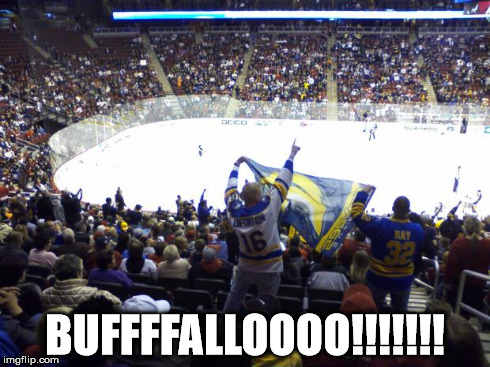
This seems like the kind of move a contender would make to bolster their roster before their playoff run. It's not going to do anything for Edmonton. First of all, it's been five years since Roy has had any sort of legitimate success in the NHL, and now that he's on the wrong side of 30, I can't imagine this will help resurrect his career. But more importantly, he signed a one year contract in the summer. I doubt very highly he's going to re-sign with Edmonton if he could potentially spend his twilight years on a contending team.
So what does this move do? Marginally improve the team now while hurting their future? Cool. Nice job. I mean, at this point the season's a total wash, so what's the upside to a slight roster improvement? Best case scenario with this deal is they move from 30th in the league to 29th or 28th, and then their odds at McDavid/Eichel go down.
So what does this move do? Marginally improve the team now while hurting their future? Cool. Nice job. I mean, at this point the season's a total wash, so what's the upside to a slight roster improvement? Best case scenario with this deal is they move from 30th in the league to 29th or 28th, and then their odds at McDavid/Eichel go down.
But acquiring Roy wasn't all Edmonton did. No, no, no. They also acquired Matt Fraser from Boston in a waiver deal. Wow! Matt Fraser! You might remember him as the centerpiece of the deal that sent Tyler Seguin to Dallas. Or, maybe not. Anyway, here's a picture of Matt Fraser whiffing on a slap shot and breaking his stick.
 |
| Nice form. |
Apparently this is the only thing he's ever done, otherwise I assume they would've found a better picture of him.
A quick recap of what out buddy Matt brings to the table:
51 NHL games. 6 goals, 2 assists, 8 points. 17PIM, 65 hits 10:27ATOI, 25 career seconds short-handed, 13:22 career powerplay. So, a 4th liner who doesn't contribute on special teams, doesn't provide offence, and isn't overly physical. Nice. A good depth move, says Oilers Nation. Hey, at least he's not undersized!
The only problem I see with this is that he adds a contract to the 50-man list.......
and for another it doesn't add a contract to the 50-man list.
Oops.
Monday, December 1, 2014
Looking forward to watching some All-Stars? Montreal, Riga, Chicago, and Pittsburgh are.

Ladies and Gentlemen, your 2015 NHL all star team! The Chicago Blackhawks/Montreal Canadiens/Pittsburgh Penguins!
Now, your starting lineup, based on leading votes per position in each conference.
In the Western Conference:
Starting Goaltender, from the Chicago Blackhawks, Corey Crawford!
At Defence, from the Chicago Blackhawks, Duncan Keith! And from the Chicago Blackhawks, Brent Seabrook!
At Centre, from the Chicago Blackhawks, Jonathan Toews!
At Left Wing, from the Chicago Blackhawks, Patrick Sharp!
And starting at Right Wing, from the Chicago Blackhawks, Patrick Kane!
Now, for the Eastern Conference:
Starting goaltender, from the Montreal Canadiens, Carey Price!
On Defence, from the Montreal Canadiens, P.K. Subban! And from the Pittsburgh Penguins, Kris Letang!
At Centre, from the Pittsburgh Penguins, Sidney Crosby!
Starting Left Wing, best player in the NHL, most certainly better than Nicklas Backstrom...Zemgus Girgensons!
And starting Right Wing, from the Pittsburgh Penguins, Evgeni Malkin!
I wonder who's going to win the Phil Kessel award at this year's mid-winter classic?
Friday, November 28, 2014
Rick Nash, no longer a physical player.
Rick Nash is a changed man. Long forgotten are last season's woes, and he's moved on to greener pastures. The former goal scoring guru is back to his old ways this year, with 16 goals so far through the first 22 games of the season, good for 2nd in the NHL. After a short-handed tally this afternoon, Mike Emrick asked Eddie Olczyk what surprised him more: his struggles last season, or his bounce back so far this year. Ed's response:
I was more surprised, Doc, with how physical he was last year. I thought he was an effective player, I mean he had chances, he didn't have as many chances, but I think he was just trying to do everything. He was trying to get in on the forecheck, he was trying to hit players ... I would say probably more last year, Doc with the way that he played, or he was trying to be a really physical player, which, you gotta be a physical player in this league, but the way he was playing, I think, was more surprising.
Rick Nash, hit totals by season, since 2007-08:
2007-08: 80GP, 67 Hits
2008-09: 78GP, 71 Hits
2009-10: 76GP, 121 Hits
2010-11: 75GP, 91 Hits
2011-12: 82GP, 104 Hits
2012-13: 44GP, 46 Hits
2013-14: 65GP, 11 Hits
2014-15: 22GP, 21 Hits
Does anything stick out here? I'm noticing something about Nash's level of physical play last season. Eddie might have have accidentally stumbled onto something. Sometimes you can properly address a problem, even with all the wrong information. Another thing worth noting though might be his opportunity. After averaging around 19-20 minutes/game for his entire career, his level dropped to 17:01 last season. The shot totals were there, and realistically, so were the goals. 26 goals in 65 games isn't so bad, it's just, ya know...expectations and stuff. That, and the 13 assists last season.
The boring truth, though, is probably that he's just been lucky this year, after being unlucky last season. With a career 12.7 shot percentage, that number dropped to 10.1% last year, the second lowest mark of his career. So far this year, 20% of his shots are going in the net. Eventually this is going to regress, and Eddie will blame the slump on lack of discipline in the defensive zone, or something of that ilk.
I was more surprised, Doc, with how physical he was last year. I thought he was an effective player, I mean he had chances, he didn't have as many chances, but I think he was just trying to do everything. He was trying to get in on the forecheck, he was trying to hit players ... I would say probably more last year, Doc with the way that he played, or he was trying to be a really physical player, which, you gotta be a physical player in this league, but the way he was playing, I think, was more surprising.
Rick Nash, hit totals by season, since 2007-08:
2007-08: 80GP, 67 Hits
2008-09: 78GP, 71 Hits
2009-10: 76GP, 121 Hits
2010-11: 75GP, 91 Hits
2011-12: 82GP, 104 Hits
2012-13: 44GP, 46 Hits
2013-14: 65GP, 11 Hits
2014-15: 22GP, 21 Hits
Does anything stick out here? I'm noticing something about Nash's level of physical play last season. Eddie might have have accidentally stumbled onto something. Sometimes you can properly address a problem, even with all the wrong information. Another thing worth noting though might be his opportunity. After averaging around 19-20 minutes/game for his entire career, his level dropped to 17:01 last season. The shot totals were there, and realistically, so were the goals. 26 goals in 65 games isn't so bad, it's just, ya know...expectations and stuff. That, and the 13 assists last season.
The boring truth, though, is probably that he's just been lucky this year, after being unlucky last season. With a career 12.7 shot percentage, that number dropped to 10.1% last year, the second lowest mark of his career. So far this year, 20% of his shots are going in the net. Eventually this is going to regress, and Eddie will blame the slump on lack of discipline in the defensive zone, or something of that ilk.
Thursday, November 20, 2014
Neither was this one.

Creative fellas over there in SW Canada. This, by the way, was immediately following Getzlaf's goal to put the Ducks ahead 2-0 midway through the first period. Yeah, you show 'em! We don't need Kes! We can get our asses kicked by Anaheim without him!
Wednesday, November 19, 2014




Sunday, November 16, 2014
The (Original) Psycho Serial Killer Letter
Killing David Willard
by David Bozynski
Credit to Aaron
I brought him to the Riker Ave. dumps. There is a house that stands alone, not far from where I took him ... I took the David there. Stripped him naked and tied his hands and feet and gagged him with a piece of dirty rag I picked out of the dump. Then I burned his clothes. Threw his shoes in the dump. Then I walked back and took trolley to 59 St. at 2 A.M. and walked from there home. Next day about 2 P.M., I took tools, a good heavy cat-of-nine tails. Home made. Short handle. Cut one of my belts in half, slit these half in six strips about 8 in. long. I whipped his bare behind till the blood ran from his legs. I cut off his ears – nose – slit his mouth from ear to ear. Gouged out his eyes. He was dead then. I stuck the knife in his belly and held my mouth to his body and drank his blood. I picked up four old potato sacks and gathered a pile of stones. Then I cut him up. I had a grip with me. I put his nose, ears and a few slices of his belly in the grip. Then I cut him thru the middle of his body. Just below his belly button. Then thru his legs about 2 in. below his behind. I put this in my grip with a lot of paper. I cut off the head – feet – arms – hands and the legs below the knee. This I put in sacks weighed with stones, tied the ends and threw them into the pools of slimy water you will see all along the road going to North Beach. Water is 3 to 4 ft. deep. They sank at once. I came home with my meat. I had the front of his body I liked best. His monkey and pee wees and a nice little fat behind to roast in the oven and eat. I made a stew out of his ears – nose – pieces of his face and belly. I put onions, carrots, turnips, celery, salt and pepper. It was good. Then I split the cheeks of his behind open, cut off his monkey and pee wees and washed them first. I put strips of bacon on each cheek of his behind and put in the oven. Then I picked 4 onions and when meat had roasted about 1/4 hr., I poured about a pint of water over it for gravy and put in the onions. At frequent intervals I basted his behind with a wooden spoon. So the meat would be nice and juicy. In about 2 hr., it was nice and brown, cooked thru. I never ate any roast turkey that tasted half as good as his sweet fat little behind did. I ate every bit of the meat in about four days. His little monkey was as sweet as a nut, but his pee-wees I could not chew. Threw them in the toilet.
Subscribe to:
Posts (Atom)